Have a Blog or a Printing Press
Tuesday 16 April 2024

Labels: Blogging, Blogs, Fine Art of Blogging
posted by S A J Shirazi @ Tuesday, April 16, 2024,
,


Chillianwala Chase
Friday 12 April 2024

People of the area are eager to help “at their own expense – when you ask anybody. One finds volunteer ‘guides’ who are forthcoming with a wealth of information. Chillianwala is a historic village that played an important role in the history of South Asia. It was a battleground where British and Sikh forces fought one of the decisive battles in the history of the Subcontinent in 1849. The quiet village has not changed much since then. Only slowly old agricultural methods are changing and tractors and wheat threshers are seen in place of bull-driven ploughs. Painted double-story houses are coming up where used to be conventional mud houses. The land is excellent with record carrying capacity and the display of seasonal crops is very powerful.
The Battle fought in the fields of Chillianwala (not to be mixed with the Jallianwala Bagh massacre) was possibly the turning point for the British. Had the British lost to the Sikhs on January 13, 1849, it is difficult to see how they could have sustained their hold over the Subcontinent.
Oddly, both the British and the Sikhs consider Chillianwala as their victory. The Sikhs say it was their victory because they broke the British force and the myth of them being invincible, who were forced to retreat. The British did retreat, but three days after the battle. The British admit that had the Sikhs realized they had the advantage and continued the battle after fighting ceased at night, they would have overrun the British who were exhausted, seriously depleted, and in unfamiliar terrain. As it was, six British regiments lost their standards at the battle. The Sikhs instead celebrated victory; three days of incessant rainfall prevented them from crossing suddenly flooded irrigation drains and streams, and the British, picking themselves up, marched away in reasonable order. Since the Sikhs appear to have disengaged first, the British claim the victory.
Of the Sikh forces, history knows little, except that the British estimate of 30,000 enemies was significantly exaggerated. The Sikhs had little if any superiority to the British force of 13,000. The artillery was about equal, with 60 guns on each side. The British handling of their artillery was much better than that of their opponents, and this was a winning factor in all the battles for the Punjab. The Sikhs were led by Sher Singh Attariwala and were deserted by some of their allies such as the Rohillas, and the Dogras under Colonel Stienbach, a former employee of the Sikh government, who turned coat to fight for the British.
The British were led by the 70-year-old Lord Gough, a fiery fighting general who was replaced despite the victories. Blame for the high casualties seems to be one reason. The list of military disasters that the British suffered in India is long, but most of these were rationalized by British military historians by highlighting situational factors that made British defeat certain and inevitable and was in many cases due to circumstances involving overwhelming numerical inferiority, excessive battle exhaustion, adverse weather and terrain.
The Battle of Chillianwala is, however, one odd exception and stands out as a battle in which the British failed to defeat their opponents despite having the advantages of the weight of numbers, ideal weather and terrain, and superior logistics. A succession of British military victories since 1757 barring few exceptions like the Battle of Pollilore (September 10, 1780), Siege of Bhurtpore (1804-1805), Monsoon’s Retreat (1804), Kabul Brigade’s Retreat (January 1842) which were dismissed as exceptions (to the general rule of “European Superiority) by virtue of exceptional numerical or other odds; it was assumed that no native army of India, Nepal or Afghanistan could stand a determined bayonet charge by the Red Coats. A feeling of superiority was produced accompanied by the natural attitude of overconfidence and rashness, and most British commanders felt that simply a direct march to the sound of guns and a simple frontal assault using “Cold Steel” was enough to disperse any native army however tough or well trained. The use of maneuver and the fact that a British army could ever be surprised was dismissed as impossible. Thus once the British suffered a rude reverse accompanied by heavy casualties despite having all the advantages; public opinion in Britain was shocked.
British Army despite a high European troop component, sufficient artillery, and two heavy cavalry brigades to ensure that no one could surprise them, little campaign exhaustion having fought no major battle since assumption of hostilities, winter weather negating the possibility of heatstroke and cholera the worst killers of white soldiers in India, failed to defeat the Sikhs. This is why Chillianwala stands out as a battle that changed Indian perceptions about British military effectiveness? The damage done at Chillianwala to the prestige of British arms was enormous and played a major role in changing Indian attitudes about the British. Though defeat at Chillianwala was forgotten soon enough and Gough again became a hero. Thanks to “angling” by the British historians.
In fact, the Sikhs did ask for a ceasefire and for terms after the battle, because they could see their end was near. Their requests were rejected; thirty-nine days later, the Battle of Gujrat was fought. The Sikhs lost. Those who were captured were killed; those who still refused to surrender were hunted down and killed. Of course, what happened to the defeated Sikh army was nothing compared to the wholesale atrocities inflicted by the British on Muslims during the war of Independence of 1857 and the civilians who happened to get in the way, but that is another story. After Gujrat, the vast area passed from the heirs of Maharajah Ranjit Singh to the sons of John Company, and ten years later, to the Imperial crown. At Chillianwala the Sikhs offered the fiercest resistance; yet, once defeated, they willingly entered British service, becoming, along with the Gurkhas, among the Empire’s most faithful servants.
Nothing is left of the history on the ground now. The only sign right on the Kharian-Mandi Bahaud Din Roadside is a British cemetery, commonly called Gora Qabristan, outside the village. Among the dilapidating graves, stands tall memorial Obelisk, like an obelisk built at Killa Kohna Qasim Bagh in Multan, and a Cross in the memory of those British who were killed in the Battle. The boundary wall of the cemetery too is falling apart and is used by the villagers for drying dung cakes. The children are seen playing Gulli Danda – local cricket in the parameter.
Nearby, there is an ancient banyan tree where busses plying on the route stop and from where villagers, oblivious of the past history of the place, board the overloaded busses to go to the town for exchanging commodities. The Union Council can hardly be expected to take care of the memorial or the historic graveyard. Maybe someone should think of preserving the past relic. It is part of our history.
The ionic counterpoint is the lack of attention to maintaining the bits and pieces of unique heritage. The neglect may be attributed to a lack of awareness, education, coordination between authorities, economic constraints, and or simply natural hazards. There is a need for information in the form of travel guide writing, pure travel journalism, travel book writing, and geographical description in the form of maps. No ordinary coldness of phrasing can express the surprise and delight, with which one makes acquaintance with the sites. Their perspective gives you a wonderful sense of being there.
Labels: Chillianwala, History, Travel
posted by S A J Shirazi @ Friday, April 12, 2024,
,
Fine Art of Mud Architecture
Thursday 11 April 2024
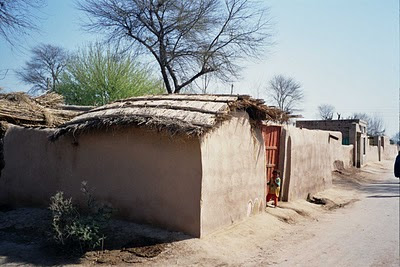
Having grown up in mud house myself (before I moved to urban center), mud buildings have a special place rooted deep in to my cultural consciousness and this personal bond encourages a more intimate relationship between me and the mud as the material transformed from formlessness to form. Hence my interest in mud architecture and how I see its future in Pakistan.
Work has already started and many experts are critically analyzing the more purposeful use of mud as a building material. Dr. Gus Van Beek of the Department of Anthropology, National Museum of Natural History is working on a book in which he is examining methods of construction and varieties of designs in contemporary as well as ancient structures found at many places. Dr. Gus Van Beek’s research started when he uncovered arch and vault construction at Tel Jemmeh, Israel. Dr. Gus Van Beek is covering major types of construction in Morocco, Egypt, Yemen, Israel, Syria, Iraq, Iran, India and Pakistan.
At local level, Society for the Promotion of Art and Culture (SPARC), registered in Lahore since 1994, is undertaking the task of revival of much needed mud architecture in Pakistan. SPARC planning to hold workshops at different art and architecture institutions in order to restart the traditional building with mud in rural as well as urban areas of Pakistan. These workshop will not only create awareness and initiate a thought process at gross roots level but will also train SPARC employees in mud architecture. Dr. Norbert Pintsch from Senior Expert Service (Bonn, Germany) is planning to present new techniques of mud building to adapt the construction technique mixed with appropriate technology in Pakistan.
Prof Dr Norbert Pintsch is an experienced architect by profession and mud enthusiast by choice. Since completing first building project as an architect at the age of 18, Prof Dr Norbert Pintsch has been in various activities as an architect and civil engineer all his life. One of the best starting point for Prof Dr Norbert Pintsch may be a mud building that stands in Peerzada Festival Area, Green Acre, Lahore. Renowned Pakistani architect like Ghayyoor Obaid are also keen on mud architecture there. Any other example that I know of is remains of Sher Shah Suri built mud fort in historic village Sher Ghar near Okara.
The mud architecture is a great resource that focuses on architecture constructed of mud brick, rammed earth, compressed earth block and other methods of earthen construction. The proliferation of concept to use mud and improved techniques in order to raise the level of living in the population is a very welcome idea and we in Pakistan need that. This can go a long way not only in the form of changing the look of population centers, rural as well as urban, but also in solving environmental problems and problems related to use of energy and other finite resources.
Labels: Norbert Pintsch, Thatta Ghulamka Dheroka, Thatta Kedona
posted by S A J Shirazi @ Thursday, April 11, 2024,
,
What it takes to be happy?
Thursday 4 April 2024
Ashiq has been working as a cleaner at our home for two years. My friendship with him developed when brought me laddoos on the birth of his son. It was a very pleasant surprise though later my wife and children hesitated to share the sweets with me. I offered him a cup of tea over which he started talking and gave me the chronological narrative of the life, experience and reminiscences. Then we used to talk whenever got chance to meet on holidays mostly, when he was late doing his job at our place or I came home early. He may not be a good communicator, but has definitely enriched my vision. He is so candid and honest about every thing.
posted by S A J Shirazi @ Thursday, April 04, 2024,
,
Calling Abdalians
Friday 29 March 2024
 Comfortably tucked in green hills north of Islamabad, Hasan Abdal is situated right on the Grand Trunk Road. The town's claims to fame are Cadet College and temple of Panja Sahib. This small and clean historic town neat is sacred for Sikhs.
Hassan Abdal is famous for its cadet college and also serves as the gateway to some most stunning sites in Pakistan. It is from here that Karakoram Highways turns towards Northern Areas. It is a convenient halting point of Grand Trunk Road (G T Road) from where one can go to places like Abbotabad and Northern Areas, Peshawar, Taxila, Wah, Rawalpindi. Coins of the Greco-Bectrians kings discovered from the adjoining tract suggest that the area was inhabited in first century B.C. Accounts of Xuan Zang, a seventh century Chinese Buddhist traveler tells us that the place was also sacred to Buddhists. However, presently the town is associated with Guru Nanak, the founder of Sikh religion and Baba Wali Qandhari, a revered Muslim saint.
Labels: Hasan Abdal, Panja Sahib, Travel
posted by S A J Shirazi @ Friday, March 29, 2024,
,
Gogera Sadar
Tuesday 12 March 2024

The only historic building — a British court — that reminds of the colonial period has been converted into a school. The verandas of the old building with round arches have been clogged to create additional rooms and red thin bricks are covered with coats of whitewash. It was much better if the building could have been conserved in its original shape. That does not seem possible now.
Labels: Gogera, History, Travel
posted by S A J Shirazi @ Tuesday, March 12, 2024,
,
Happy families are all alike
Saturday 9 March 2024
posted by S A J Shirazi @ Saturday, March 09, 2024,
,
Judge the Nations by the Way They Look at Their Women
Saturday 2 March 2024
 Societies pride in different strengths: Some give importance to bravery, some to democracy, and some nations think that freedom of expression, development, and or education are the hallmarks of their long-term sustenance. “The nations should be judged on how they look at their women,” writes Abbas Khan, the author of the Urdu novel Mein Aur Umrao Jan Ada, his eleventh.
Helen of Troy was the daughter of Zeus and Leda and the wife of Menelaus, considered to be the most beautiful woman in the world. Her abduction by Paris caused the Trojan War and made thousands of ships drown.
Labels: Abbas Khan, Books
posted by S A J Shirazi @ Saturday, March 02, 2024,
,
Changing Chitral
Friday 1 March 2024

This is Chitral. On the small airfield, the cold wind thrusts you to shiver. The remoteness of the district has left it undeveloped in spite of its grand natural beauty, hospitable people, and ancient history. The town is a base camp for tourists, adventurers, and researchers from across the world. And, people seem to be living there in peace.
posted by S A J Shirazi @ Friday, March 01, 2024,
,
Historic Trilogy
Thursday 29 February 2024

posted by S A J Shirazi @ Thursday, February 29, 2024,
,